Thursday, May 23, 2013

Il Battessimo: My Calabrese Baptism


Walking past the fountain on the morning of the Baptism.

Ordered from Polistena, by the kilo. Cake and cream perfection.


And what's a special occasion without Prosecco?
As spring has arrived and summer is approaching, we are thinking about vacations. And of course, in our house, Italy is ever present at the top of the list of possibilities.  It's technically a holiday but with family to visit, it is much more.  Emotionally, it's both difficult and wonderful.  Difficult because there have been loved ones pass on and there have been tragedies.  The wonderful comes in the form of happy endings, weddings and babies.

We were in Italy for two reasons during the summer of 2010: our cousin's wedding and our son's baptism.  Outside of his immediate family, one remaining uncle and a few cousins, my husband's entire extended paternal family resides in Calabria so it always feels like there are people missing at major events here in Canada.  I figured that since there would be so few of these occasions in the future that we could share with each and every one of them, the elderly that can't travel and the young, whose families are growing, the opportunity to share both these celebrations is one we should not miss. 

So we went. 

We arrived, not entirely certain that the Priest, Don Salvatore, would agree to baptise a child who would not be joining his parish.  But after a conversation with, first, his devout Godmother-to-be, and later myself, he agreed.  He wanted to be certain that this was not some sort of tourist novelty and that we were serious in our intent to bring a child to the church for such a sacrament.

With a baptism date set, we began planning the feast we would share with family and friends.  The venue was a given, at Zia's house under the vines and the menu, a simple country lunch.  Nearly everything that would be part of that meal would come from local purveyors and artisans and cooked with care.  We made the rounds to pre-order meats, pick up cheeses, buy copious quantities of prosecco and of course, arrange for the cake. 

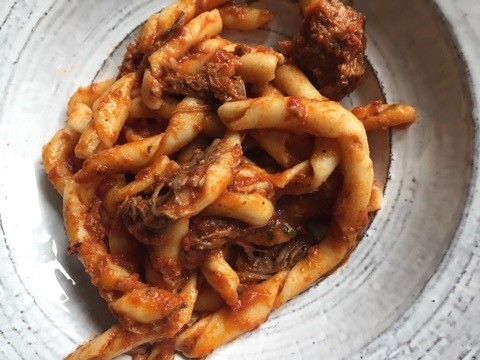
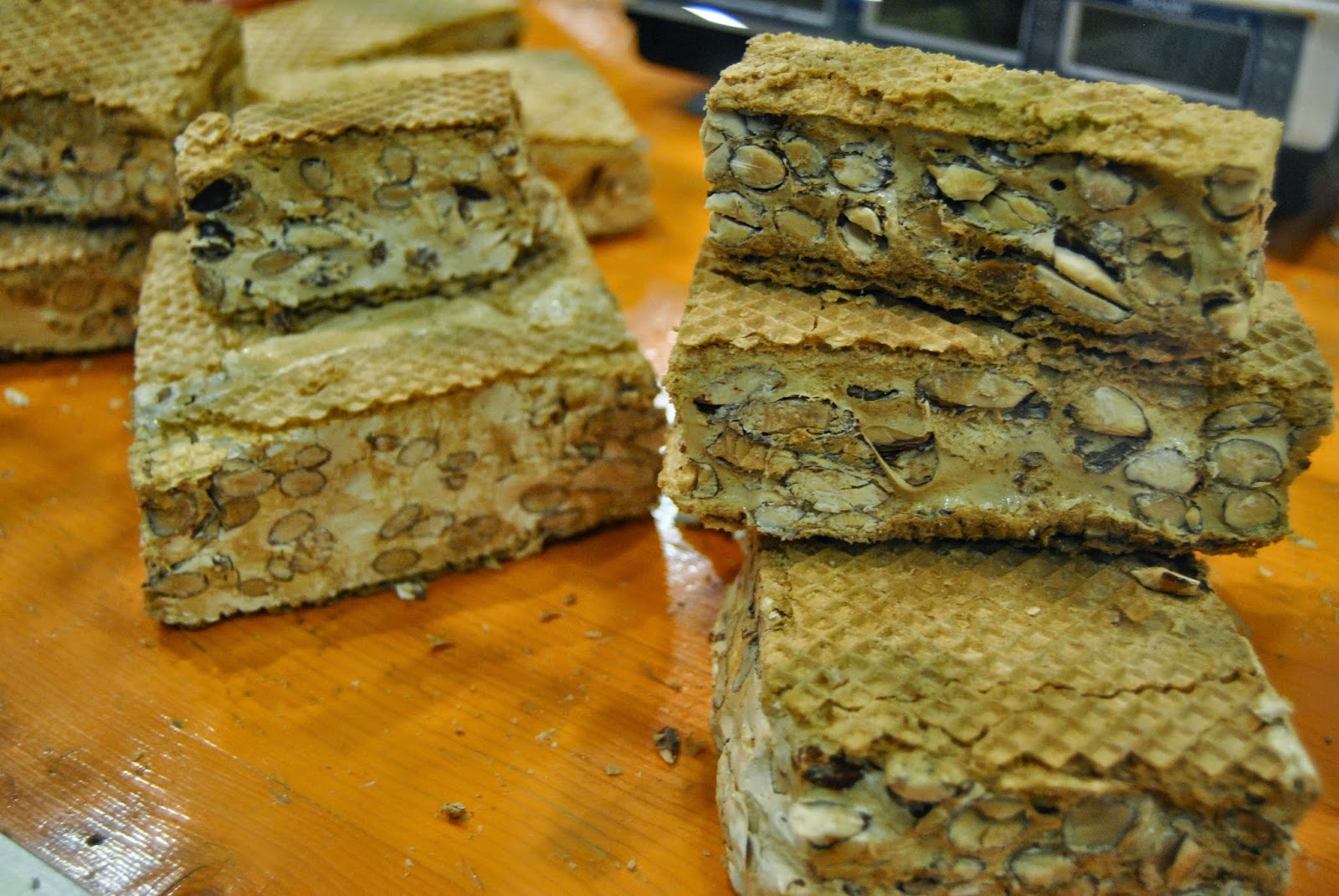
The meal would start, of course, with antipasti of local cheeses, preserved vegetables and cured meats.  My favourite are the tiny mountain mushrooms packed under olive oil (funghi sott'olio), a specialty of our good friend's mother. The pasta course would be the typical maccheroni Calabrese with sugo made from young goat and followed by the tender goat meat, a mixed grill of sausages and chicken spiedini with salad.  In Canada, a home-made cake and various cookies would be dessert but not (and nor would I dream of it) in Italy.  Here the local artisans take pride in producing the most exquisite of sweets, both traditional and modern.  The finale would be an ethereal custard filled confection from Pasticceria "Millevoglie" in Polistena.   

On the day of, the earth was swept and evened slightly and long tables were brought out covered in stereotyical Italian tablecloths.  My mother-in-law and cousins had started the prep the evening before and were up early to finish the sauce and make sure everything was in order.  I tended to getting our little man ready.  It turned out to be a mission to get him into actual clothes since, in but a few short weeks, he'd gotten well accustomed to wearing little more than a nappy.             

The road into San Giorgio Morgeto winds up the side of the mountain to the edge of the old town.  There, at the foot of the fountain, you can either keep to the right continuing around the mountainside into the forest and further into the Aspromonte or take a sharp left and then, on foot (or only with a very small vehicle), manouvre your way through narrow streets to the church.  San Giorgio Morgeto is a classical example of an Italian hill town laid out in a medieval fashion with limited vehicular access in certain quarters.  Built over centuries, many 'streets' are a series of steps that seem to have been determined by the natural contours of the mountain.  Only the elderly, who are unable to manage the inclines, take advantage of the adventurous drivers willing to navigate the gauntlet (3 point turns and tucking in mirrors to barely miss curtains and geranium planters) to get to the church.  Most walk, dropping off their passengers at the fountain and parking at the foot of the hill.

The baptism service was held for several children that day and went well.  Unfortunately, I don't have too many family photographs because in the absence of a very stern photographer barking orders (usually me) it is difficult to corral the in-laws to 1) stand close enough together, 2) stop talking and gesturing, and 3) hold still and smile.  I have only ever seen ONE photo of my father-in-law where he doesn't look like he's standing for what one might think would be his last photo.  Photos of the after party abound and are all candid family shots that I will treasure.

To end the meal, the charming bakers at Pasticceria "Millevoglie" made the most divine cake layered with crema pasticcera that tasted just like the famous trifle-like dessert zuppa inglese. The flavouring is of course, was very similar to alchermes which is used in the making of traditional zuppa inglese, best described here at All Things Sicilian And More.

That cake, one of the most memorable for so many reasons, is simply one of the best things I have ever tasted and, judging by the amount of icing (or lack thereof) on a pair of wee hands and a little chubby face, someone else thought so too.  Flavour and texture perfection.

The day was also capped off with cups of espresso and lots of prosecco.

After a long warm day, the wee man (as with the rest of us) slept very well that night.

I am so grateful for our family, friends and the local artisans that made our son's day so special. 

We are so blessed. 

Wednesday, April 24, 2013

Tales of Ajvar

The best pepper paste ever?

I love that my city embraces a myriad of cultures, enough to host cultural/regional specific festivals, home to many country specific clubs and associations and also many small import grocery stores specialising in the food of a variety of countries. Within but a few kilometers, there are Italian, British, Polish, Dutch/Indonesian, Thai and Croatian grocers/shops.  It is quite impressive to be able to have crumpets and golden syrup for brekkie, an authentic mortadella sandwich and chinotto for lunch, an afternoon snack of kielbasa and dinner of Indonesian curry all in one day.

However, trying to keep with my fresh and local mantra, I have to admit to not frequenting these stores too often, either only to get something to enhance my garden goodies or try something new and different and usually recommended to me by a friend.  It's the locavore's dilemna.  But, today, I had to check this out.  I work with a ex-pat Macedonian who is only too happy to share food stories and I am a more than willing ear.

He tells me tales of ajvar, his mum and grandmother and that it's alot different just to get it out of a jar without all the work, but what delicious work.  This photo shows a part of the process.  Can't you smell the peppers roasting now?

Mama's ajvar: A roasted red pepper spread that also contains eggplant (aubergine).  It is available in mild, hot and green pepper varieties.

We've been enjoying its unctuous, concentrated pepper flavour on fresh and toasted bread as an appetiser. Divine!

 Na zdravje!  

Wednesday, April 10, 2013

More than cheese in 2013


Marzipan pears at Slow Cheese (Bra, Italy - September, 2011)


It was an incredible week at Slow Cheese, 2011.  There was so much to absorb in a short time, I was happy that I had sessions booked and did my researchStill, the Italians are so organised, you could still just show up and have a great time.   

First of all, the cheese was amazing. I tasted rare and regional cheeses unlike which I have tasted before or will again until the next time I'm fortunate enough to travel back.  The food was absolutely stellar and the wine lists at the various venues were nothing short of fantastic.  These were never concerns going in.. however, the biggest surprises were found in the beer tent, the street food and some other unique artisan food stalls around Bra.

These marzipan pears (the photo above is of tiny marzipan pears, not real ones) found at the Sicilian products booth are a prime example.  I bought a few as a treat for my suocera.  Also at this stall were the best cannolu I have ever tasted.  Rich with ewe's milk ricotta and bejewelled with the crushed pistachios, I ate one on the spot and bought another for breakfast the following day. 

Since Cheese 2013 is coming up, I hope a few retrospective posts can help you decide to book your tickets.  If you have any questions or concerns about traveling to the land of Slowfood for all things cheese (and then some), I'd be happy to answer them as best I can. 

Mangia!


Friday, April 05, 2013

The Sangiorgio recipe project

San Giorgio Morgeto, RC
 
I am working with my suocera to compile some recipes.  I won't call them 'Italian' (obviously, I think the regionality of Italy is well-establised), sort of Calabrese, but mostly Sangiorgese 'recipes' or the variants of common local/regional dishes made with her San Giorgio (and now, after nearing 40 years, a Canadian) twist.  It is a work in progress, a mission to save and preserve things that I do not want lost.  Spring (and this book) has inspired me and my suocera seems to have gotten over being bothered my desire to weigh and measure and write more detailed instructions.  Is it possible that I've become more stubborn and she has become less so? Hmm. 

Will I extract measurements and methods from this wise old woman?  We'll see. 

The names of some of the dishes, I am not even entirely sure how to spell given that the dialect is more of a spoken language and, what I have seen written, defies rules of traditional Italian.  It is a very old language, a precursor to Italian with Arabian, French and Greco influences shared with Sicilia and Sardegna. So bear with me and if you have a suggestion, for the words, spelling or a recipe - I know there are Calabrese far and wide around this planet, please let me know.

The first installment is in the works.  We're in the process of picking a day, deciding what we are going to cook and then, getting the ingredients.  I am long and inexcusably overdue to post about a certain cookie recipe so that might be a good place to start.

Looking forward to sharing the discoveries. 

Sunday, March 31, 2013

Buona pasqua 2013

In our house, Pasqua means visiting, family dinner and sweets.  The visits happen after Easter Sunday mass,  family dinner always involves homemade pasta and lamb and 'sweets' run the gamut from traditional columba and a variety of fried treats.  Company usually drops in for an espresso after the main event so it is always nice to have a nice mix on the dessert menu.  

I'd only ever made soffioni di ricotta once before and I'd been brainstorming a way to eat more ricotta (I love ricotta) so that was no contest.  And while I don't have access to the ethereal ewes milk version (yet), I do have a local shop within walking distance that brings in fresh whole cow's milk ricotta every other day.  Have one look at MuccaSbronza's soffioni di ricotta and you'll be feeling the ricotta love too. They are that gorgeous.  
 
I was also inspired to make an old stand-by, tiramisu, when I noticed Galbani brand mascarpone at the local deli (they only carry it occasionally) - definitely a sign.   So I also made Mamma Papera's Tiramisu.  Her photos are infinitely more beautiful, and mine, well.. not so much.  But this recipe is a keeper.  Made a day ahead of time, it sets up beautifully and flavoured with my favourite (Amaretto diSaronno) and a bit of rum (my suocera's secret favourite - got to keep Mamma happy too), it was a treat indeed.    


Why don't I have any pictures save for the one I took with my phone?  Between getting a  13 x 9-inch baking pan (that's 32.5 x 23-centimeters) chokka full of tiramisu, a tray full of soffioni and a helpful 3 year old (carrying an equally disastrous combination - cocoa and powdered sugar!) out the door, I didn't take any.  And once I joined the wonderful chaos and commotion that is dinner at Nonna's house, I completely forgot until it was on the plate.       

Grazie Mucca Sbronza e Mamma Papera for your contributions to our Easter Feast.

Buona pasqua a tutti!. 

Saturday, March 30, 2013

Malloreddus


What a difference a year makes.  If you are only 3 years old, it's a good sized portion of your existence.  Already someone is a great wee helper and, over the past year, has developed a relative understanding that dinner just doesn't magically appear.  As well an activity we do together, I think it is important to make food and it's preparation part of his young life and I hope that it will establish some traditions for him to carry into his teenage years, young adulthood and beyond.  

We make alot of dough here at la tavola.  Not in the slang sense, as what I 'do for a crust' (day job) doesn't result in alot of dough (money) but it has the priceless benefit of giving me time to spend with family and at home so that homemade bread and pasta are back to being regulars on our tavola.  I'm not sure if 'dough' was part of my vocabulary at that age but almost every afternoon when we arrive home, I'm asked if we are making dough.

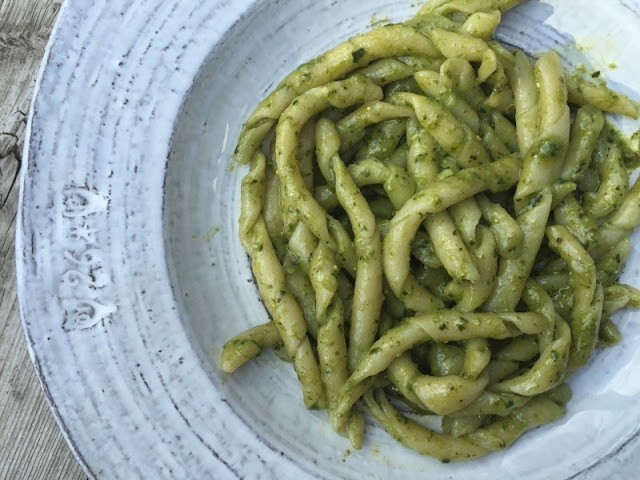
On Thursday evening, that dough was for bread and this morning, I made a batch of dough that will become malloreddus for tomorrows Easter lunch.  I like malloreddus because of its compact nature (read: perfect size for small utensils and a wee mouth) and for its compatability with various easy to make sauces: endless meat free options, a simple tomato basil preparation, seafood or pantry staples (olives, capers, etc.).

With the widening availability of various kitchen gadgets and attachments for classic pasta makers and people's willingness to give handmade pasta a go, I find these short dumpling type pastas are a good place to start your foray into the world of homemade pasta.  I've been making Malloreddus (origins in Campidano dialect) from Sardegna (aka gnocchetti sardi) and cavatelli from Puglia with a vengence.  

A good malloreddus primer here. And if ricotta cavatelli sounds good, one of the best 'how to' on the web can be found on Deborah Mele's site: Italian Food Forever.  These are similar in shape but, of course, hand rolling versus using a small hand turned machine will make some textural differences as well as maybe some small tweaks in the the recipe used for the dough to suit your personal taste and whatever ingredients you have available to you. 

The dough I make for malloreddus follows the above recipe link but I use a little less water.  The reason being is that the durum wheat semolina 'flour', or the readily available sort, here in Canada, is coarser than the Italian semola di grano duro 'rimacinata" and doesn't absorb all the water (you'll end up kneading in heaps more flour).  The texture is not quite cornmeal but nowhere near the finely ground Italian versions available at specialty shops.  I found the Italian milled semolina di grano duro works perfectly in the LCI recipe.

Also, I find that a slightly drier dough than typical rolled pastas performs better mainly because these dumplings are curled (either through the rotory action of a machine or dragged under your thumb if using a gnocchi type board) to create a ridged outer surface and a ragged interior.  If the dough is too wet/tacky, the final pasta will not retain this shape, the inner groove of the "shell" will seal (stick to itself) and cook to a thick chewy mass.  It has to be tender enough to be workable and firm enough to maintain the curl and sauce soaking interior at least while you are making all the pasta.  It takes a little elbow grease, and practise, but is worth it.  You can measure the coarse durum wheat semolina in a cup measure as it isn't as susceptible to environmental moisture.

The water.  I use filtered water for the dough and heat it quite warm to touch.  To this I add a pinch of crumbled saffron and set it aside to cool a little. Warm water will help in hydrating the protein in the flour and also coax a little more flavour/colour from the saffron.

The basic dough ratio (makes enough for 2 primi): 1 cup semolina (Unico brand), 1/2 tsp salt and about 1/3 cup of warm golden saffron water.  Place the flour in a medium bowl and make a well in the center.  Add the water and stir to a shaggy, but kneadable, mass.  Remove dough from bowl and place on work surface (preferably wood) dusted with more semolina.  Knead for several minutes adding more semolina as necessary but making sure that the dough doesn't show signs of small 'tears', indicating that it is getting too dry.

Cut the dough into smaller portions (this will depend on your preference and how much dough you've made, but for 1 cup of semolina, I find quarters work well) keeping the remainder of the dough wrapped in plastic to keep from drying out.  Roll the portioned dough into a rope about the thickness of your thumb or finger. If you are using a machine, you can feed the dough rope through the rollers and catch the pasta on a lightly semolina dusted platter below.  If you are using a board, cut the rope into roughly 1.5 cm pillows.  Again, I tend to keep these on the small side. Using your thumb and applying even pressure throughout the entire motion, drag and roll the little pillow over the board under your thumb with one steady, even motion.  Give it a few tries and play with the pressure to get the thickness as you like it.

Either way, the finished pasta should have nice grooves on the top surface and underneath, if you pry open the little shell, you can see the dragged, slightly ragged inner surface of the pasta.  Keeping this shape, the pasta will cook evenly and hold just the right ratio of delicious sauce to pasta. Paired with a sausage or mushroom ragu, this is an easy and kid friendly weekend dinner.  And, good help being hard to find these days, I consider myself quite lucky.  If you've got some small hands to keep busy and dinner to get on the tavola, this is the perfect project.

Mangia!

Friday, March 29, 2013

venerdi santo


It's Good Friday and we are getting ready for mass.  Tonight's menu will continue the tradition of not eating meat on Fridays throughout Lent.  Since we typically eat a few vegetarian meals per week, meatless Fridays don't pose much of a challenge.  We love legumes, vegetarian risottos, seafood and, of course, the versatile egg. 

Eggs play a big part of the traditional Easter menus and celebrations.  Elaborately coloured and baked into breads or covered in brioche, they also take the star role at a tavola in the simplest of recipes: fritatta.

I've followed this recipe (courtesy of Italian Food Forever) full of gorgeous fat asparagus, omitting the pancetta and separating the eggs.  Whipping the whites solo allows them to contribute to a loftier set in the finished fritatta without compromising any flavour.  I didn't beat them to dryness just rather a sleek barely holding peak. I was after fritatta middle ground, more than a dense pancake but not a foamy souffle.

As for cheese, there are few and far between that don't complement eggs.  I used some robiola due latte (not unlike this one) that melted into liquid bliss and married the potatoes, asparagus and egg perfectly.  Parsley is the herb of choice here but, again, whatever you fancy will likely work just fine. If you've got bacon and eggs with fresh greens, mushrooms or spring onions, the delicious possibilities are nearly endless.

Along with fritatta and a green salad, we opened a bottle of Vinea Veronese Garganega 2011.  I particularly favour Sauvignon blanc with spring egg dishes, however, I quite enjoyed this Garganega in its blended style. Slight creamy almond mealy goodness balanced with pear/apple fruit and citrus/minerality all in one. With lovely length as well. I suspect that, while good with our lunch, it will be even better with our tempura battered seafood dinner tonight. 

Mangia!